Ask most people to picture Henri Matisse and they’ll see color: the electric red of The Red Studio, the sun-drenched interiors of Nice, the wild, clashing hues that got him and his friends branded “Fauves” – wild beasts – in 1905. Colour was his reputation and, by his own admission, his obsession. He spent a lifetime chasing what he called an art of “balance, of purity and serenity,” and he found it, again and again, through pigment.
So why did a man so devoted to color spend nearly five decades – from his first etchings around 1900 to his final linocuts in the 1950s – obsessively making black-and-white prints? Why would the most famous colorist of the twentieth century keep returning to a medium that stripped color away entirely, working in editions of etchings, drypoints, lithographs, linocuts, and illustrated books alongside every major painting he ever produced?
The answer is that for Matisse, printmaking wasn’t a side hobby, a way to make quick money, or a lesser cousin to “real” painting. It was where he thought. It was the stripped-down laboratory where he tested what a single line could do once you took everything else away – and the record shows he took that laboratory as seriously as his canvases.
Strip It Down to Find What’s Essential
Matisse described drawing as a process of purification, a paring-away of everything inessential until only the truth of a form remained. Painting let him seduce the eye with colour relationships – a green shadow beside an orange wall, a field of ultramarine holding an entire room together. But a print offered no such luxury. Cut a line into a linoleum block, scratch it into a copper plate, or draw it in greasy crayon on a litho stone, and there is nowhere to hide. No shading to smooth over an uncertain contour, no chromatic harmony to distract the eye from a clumsy shape.
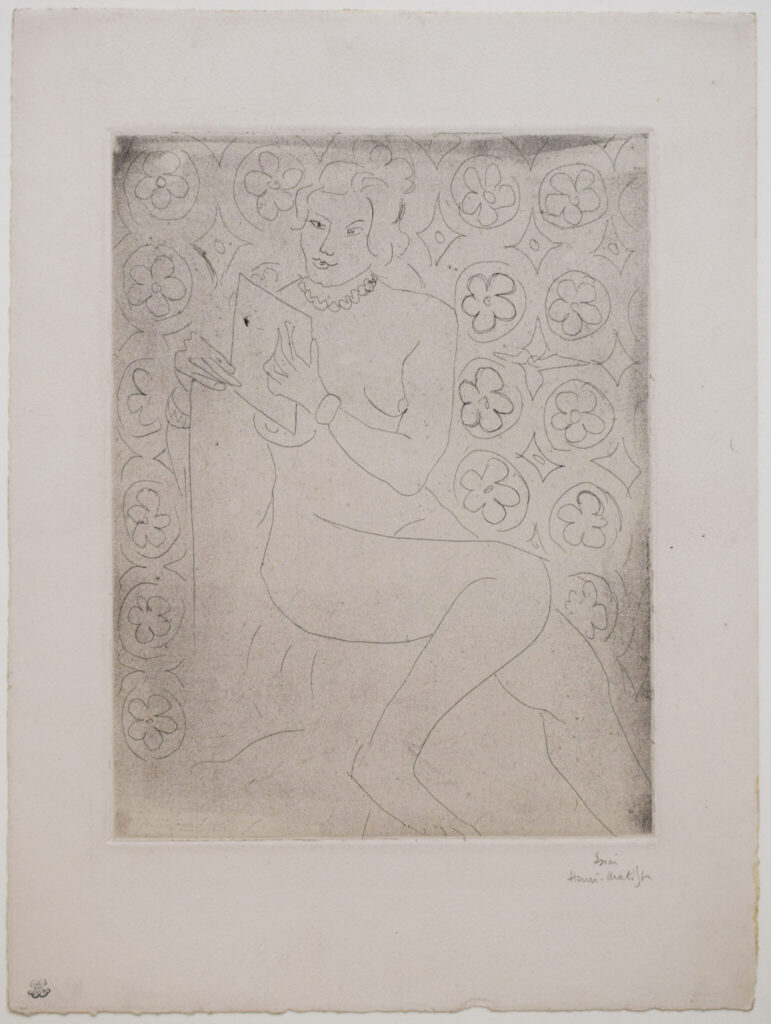
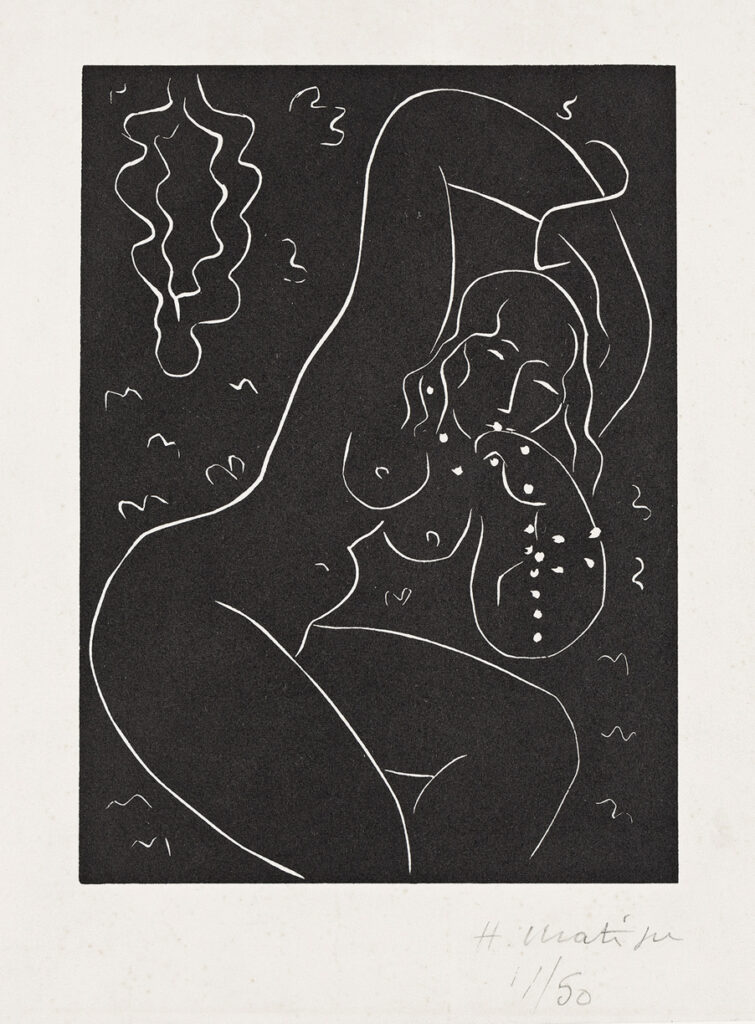
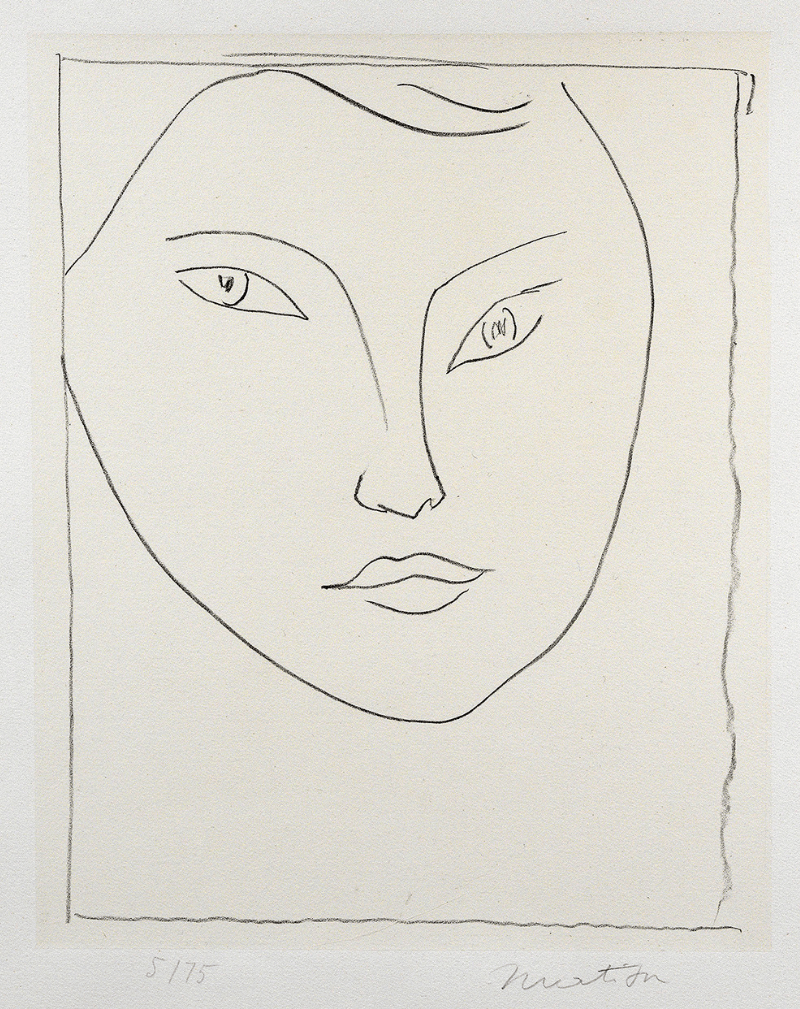
This is most visible in his etchings and drypoints of the 1920s and 30s, where Matisse drew female faces and reclining nudes in a single, unbroken contour line – pen or needle never leaving the plate. He treated this almost like a discipline of honesty: if one continuous gesture could still capture a sitter’s weight, mood, and structure without a single drop of color to prop it up, he knew the underlying architecture of the image was sound. If it couldn’t, no amount of painterly color was going to save it later. Prints were where a composition had to prove itself stripped down to its skeleton.
Figure Reading, in front of Moucharaby (1929)
Henri Matisse Gilden’s Art Gallery
Nude with Bracelet (1940)
Henri Matisse Christopher-Clark Fine Art
The Same Subject, Told a Hundred Times
One of the strangest and most telling habits of Matisse’s printmaking life was repetition. He would take a single model, a single pose, sometimes a single sitter’s face, and print it over and over with only tiny variations between states – a slightly different curve of the mouth, a firmer or looser hand, a contour redrawn just a fraction looser than the last.
This reached its fullest expression in Themes and Variations (1941-42), a suite of drawings grouped into series, each series circling one motif the way a jazz musician circles a melody, testing it from a dozen angles before moving on. Prints are naturally built for this kind of serial thinking in a way paintings are not: you can pull a plate, rework it, and pull it again, generating a whole family of related images rather than a single fixed statement. Matisse used that built-in repeatability not to mass-produce one image, but to interrogate a single idea until he had exhausted it – thinking out loud, in ink, plate state by plate state.
Even decades earlier, his engagement with reproductive processes went back to his student years, when he copied Old Master prints and studied Rembrandt’s etchings for how a few scratched lines could suggest an entire face in shadow. That early apprenticeship in economy of means never left him.
A Democratic Medium for an Elitist Reputation
There’s also a less romantic, more practical reason Matisse cared about prints: they let his work travel to people who could never afford, or never encounter, his paintings.
An etching or lithograph could be produced in an edition of dozens, priced far below a unique canvas, folded into a portfolio, mailed across an ocean, hung in a modest apartment instead of a mansion. Matisse worked for years with the great Parisian print workshop of Fernand Mourlot on his lithographs, and he collaborated repeatedly on illustrated books that paired image with text – poems by Mallarmé, love lyrics by Ronsard, verses by Baudelaire – projects where prints married visual art to literature and reached readers, not just collectors chasing a signature.
In an era when many contemporaries treated printmaking as a purely commercial sideline, something to churn out between “serious” paintings, Matisse treated it as a genuine extension of his art into the world. It was proof that an idea worth having was worth multiplying and spreading, not hoarding as a single object behind glass in one collector’s drawing room.
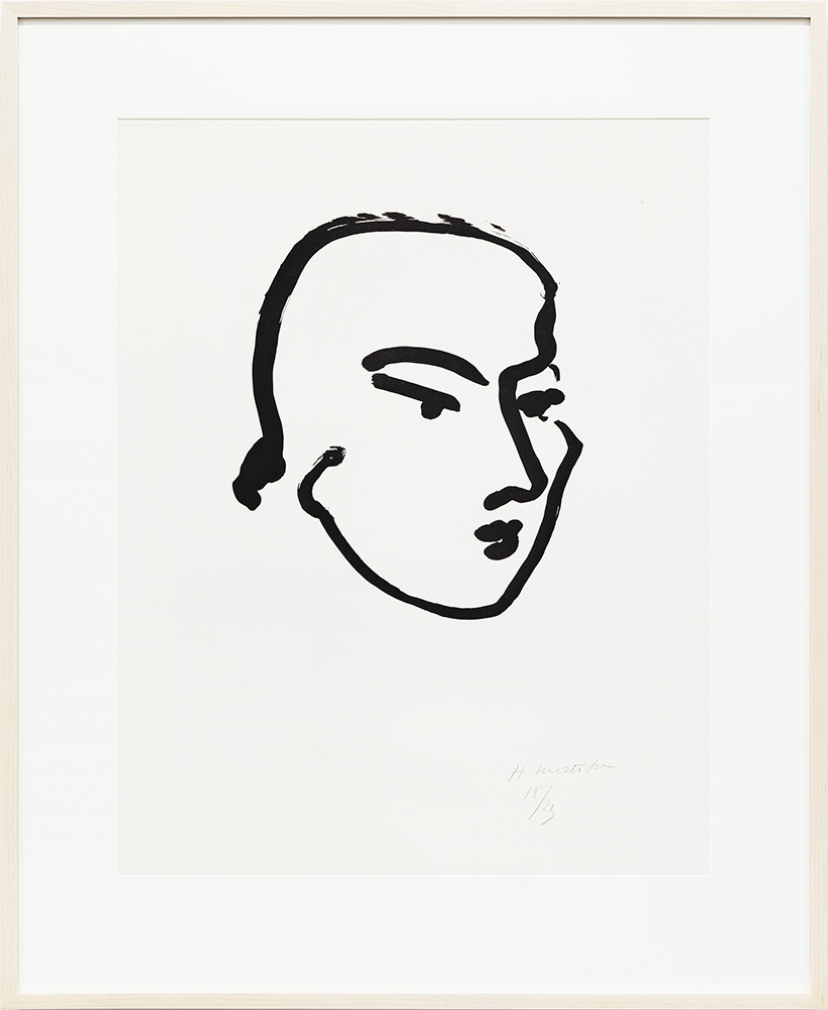
Nadia. Visage aux yeux obliques (1948)
Henri Matisse Mary Ryan Gallery
Portrait de Claude D. (1946)
Henri Matisse Sims Reed Gallery
The Scissors Were Just a Print Tool in Disguise
By the late 1940s, illness had confined Matisse largely to bed and wheelchair, and he turned to his famous cut-paper works – the gouaches découpées that produced Jazz and the great late cutouts like The Snail and The Parakeet and the Mermaid. These are usually discussed as an entirely separate, almost miraculous late chapter, disconnected from everything that came before.
But look closely at how Jazz actually reached the public: not as unique, untouchable originals, but as a portfolio of pochoir prints – a hand-stencilling technique using cut zinc templates to lay down flat, saturated colour – published by Tériade in 1947 so the vivid, scissor-cut shapes could circulate as a reproducible edition, just like his etchings and lithographs before them. Even at the very end of his life, when his medium had transformed almost beyond recognition, Matisse still reached instinctively for the logic of printmaking: refine an image down to its essential shape, then multiply it so it could exist in many hands, many rooms, many lives at once, rather than just one.
What the Prints Were Really For
Matisse once insisted that a finished work must carry within it “a complete sense of the disposition of the objects” – total clarity, nothing extraneous, nothing left to chance. Prints were how he trained himself against that standard, and how he tested himself whenever he doubted he’d met it. They were the sketchbook that got taken seriously, the discipline hiding behind the decadence of color, the black-and-white skeleton quietly holding up everything people remember him for.
He didn’t make prints because he had run out of things to paint, or because a dealer asked for something affordable to sell. He made them because some ideas can only be found by taking the colour away entirely and seeing, honestly, whether the line still stands on its own – and because once he found the image worth keeping, he wanted as many people as possible to be able to hold it.