There is a reason revolutions are rarely painted first – they are printed first. Long before Social Realism hung in museums, it was pulled through a press, wet with ink, and pinned to the walls of union halls, tenement stairwells, and picket lines. If you want to understand how art learned to speak for the working class, forget the canvas for a moment. Start with the plate, the stone, and the block.
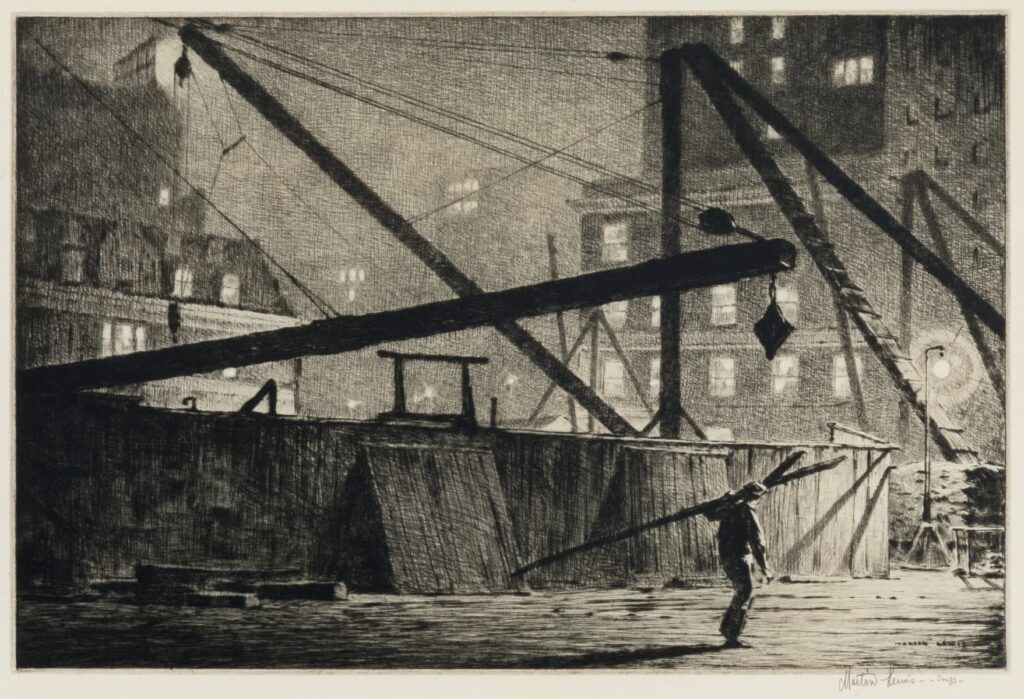
Derricks at Night (1927)
Martin Lewis Catherine Burns Fine Art
First, What Was Social Realism Fighting For?
Social Realism emerged in the early 1930s, forged in the wreckage of the Great Depression, though its roots stretch back to the gritty urban scenes of the Ashcan School painters in the early 1900s. As breadlines lengthened and factories emptied out across the United States and Europe, a generation of artists rejected abstraction, decorative Modernism, and idealized subject matter in favor of something blunter: the unglamorous, unposed reality of ordinary people under economic and political strain. Coal miners, migrant farmworkers, tenement dwellers, striking laborers, and the unemployed became the movement’s true subjects — painted and printed not as symbols, but as individuals worth looking at directly.
The movement wasn’t confined to one country or one style. In the U.S., it overlapped with New Deal-era public art programs and artists like Ben Shahn, Reginald Marsh, and the Soyer brothers. In Mexico, it fused with the muralist tradition of Diego Rivera, José Clemente Orozco, and David Alfaro Siqueiros, who saw art as a tool for revolutionary education. In Germany, it drew on the searing empathy of Käthe Kollwitz and the biting satire of the Neue Sachlichkeit (“New Objectivity”) artists responding to war and inequality.
What united these otherwise distinct scenes was intent, not just style. Social Realism set out to:
– Depict working-class and marginalised life honestly, without romanticising poverty or sanitising hardship – Critique capitalism, fascism, and social inequality, often with an explicitly left-leaning or pro-labor political stance – Make art accessible and legible to ordinary viewers, rejecting the elitism artists associated with avant-garde abstraction – Document history from below, capturing strikes, protests, and daily survival rather than the lives of the powerful
It was, in short, an art movement that treated empathy and political urgency as aesthetic values in their own right — and that mission is exactly why the print, cheap and endlessly reproducible, became such a natural extension of its ambitions.
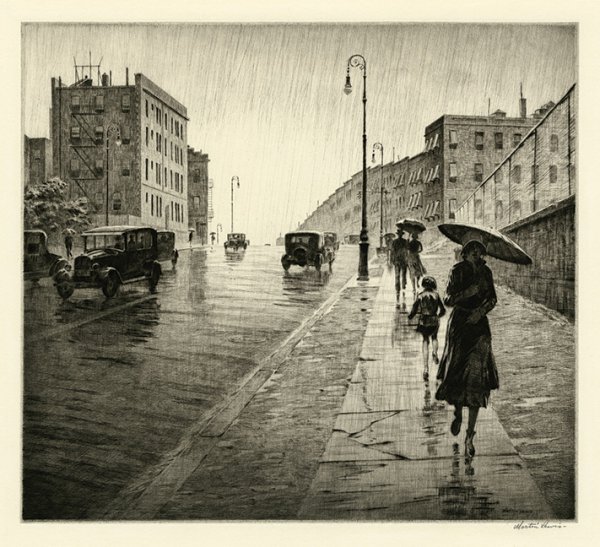
Rainy Day, Queens (1931)
Martin Lewis Harris Schrank Fine Prints
The Democracy of the Multiple
A painting is one object for one wall. A print is a hundred objects for a hundred walls — and that arithmetic is precisely why Social Realist artists fell in love with it. Lithography, woodcut, linocut, and etching could be reproduced cheaply and distributed widely, which meant an image of a breadline or a coal miner’s face could travel into the hands of the very people it depicted. Painting served patrons; printmaking could serve the public. For a movement obsessed with dignifying labor, poverty, and protest, that difference in audience was the whole point.
Käthe Kollwitz and the German Blueprint for Empathy
No conversation about Social Realist printmaking gets far without Käthe Kollwitz, the German artist whose charcoal-dark lithographs and woodcuts of grieving mothers, striking weavers, and war-ravaged families became a visual grammar that American and Mexican artists would borrow wholesale. Kollwitz proved that a print didn’t need color, gloss, or scale to devastate — it needed only honesty and a willingness to look at suffering without flinching. Her influence rippled outward across the Atlantic, shaping how a generation of American artists thought about the emotional weight a simple black-and-white image could carry.
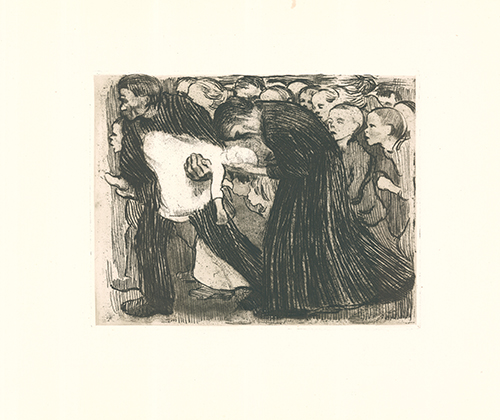
Überfahren (Run Over) (1910)
Käthe Kollwitz Sylvan Cole Gallery
Mexico’s Print Shop of the People
Just south of the border, the Taller de Gráfica Popular (the “People’s Graphic Workshop”) turned printmaking into an organized political tool. Founded in Mexico City in the 1930s, the Taller produced posters, broadsides, and portfolios attacking fascism, championing land reform, and honoring indigenous and working-class life. Its members worked collectively, often anonymously, treating the print not as a precious art object but as a piece of infrastructure — something as necessary to a movement as a printing press is to a newspaper. Muralists like José Clemente Orozco and Diego Rivera get the textbook glory, but it was the printmakers standing beside them who kept the message moving after the scaffolding came down.
America’s New Deal Ink Machine
In the United States, the Works Progress Administration’s Federal Art Project ran a Graphic Arts Division that put thousands of unemployed printmakers to work producing lithographs and silkscreens for schools, libraries, and post offices. This wasn’t a side hustle to painting – it was policy. The government understood that prints were the most economical way to fill public buildings with art and, in doing so, inadvertently built the perfect delivery system for Social Realism’s core subjects: factory workers, farmers, breadlines, and city streets. Artists like Raphael Soyer, Isabel Bishop, and Thomas Hart Benton moved fluidly between canvas and lithographic stone, often finding the print to be the more urgent, more honest medium.
Why the Medium Was the Message
Painting Social Realism might have made the movement look noble. Printing it made the movement usable. A woodcut could illustrate a union pamphlet. A lithograph could be reproduced in a left-leaning magazine. A linocut could be run off in the hundreds for a strike rally without anyone worrying about damaging an ‘original.’ The rough, carved texture of a woodblock print – its stark contrasts and visible tool marks – even came to visually signify labor and struggle, echoing the very calloused hands that were its subject.
The Legacy: Art That Refused to Stay on the Wall
What prints gave Social Realism wasn’t just affordability – it was mobility, mass address, and a kind of stubborn insistence that art belonged in the hands of ordinary people, not just above their mantels. The movement’s paintings may be what survive in museum retrospectives today, but its prints were what actually moved through the world in the 1930s and 40s: pinned up, passed around, worn soft at the edges from handling. In that sense, the print wasn’t a supporting player in Social Realism’s story – it was the movement’s original engine, quietly proving that art could organize as effectively as it could depict.