
The Primitive Matrix: How Paul Gauguin Scratched, Sanded, and Reinvented the Woodcut
Paul Gauguin spent his career trying to escape Europe – its salons, its market expectations, its polished conventions of what a picture should look like. When he finally turned seriously to printmaking in his forties, he brought that same escape impulse to the medium itself. Rather than following the refined, controlled tradition European wood-engraving had settled into by the nineteenth century, Gauguin treated the wood block like raw material fresh out of the jungle – something to gouge, scratch, sand, and rebuild by hand, again and again, until it looked less like a polished European print and more like an artifact unearthed from somewhere else entirely.
A Painter Who Never Trusted the Canvas Alone
Gauguin’s turn to printmaking wasn’t an isolated hobby – it was one front in a much larger restlessness. He wrestled constantly with what he regarded as the limitations of easel painting, and even while producing canvases with an eye toward the Paris art market, he was simultaneously exploring the expressive potential of printmaking, ceramics, drawing, and wood carving in parallel. His experiments in printmaking began in 1889 and eventually spanned etching, zincography, lithography, and monotype — but it was woodblock printing that became his most sustained and radical engagement with the medium.
That sequence matters. Gauguin didn’t arrive at woodcut as a beginner testing the waters of an unfamiliar craft. He arrived already fluent in several print techniques, and chose woodcut specifically because something about its physical bluntness matched what he was after better than any of the others could.
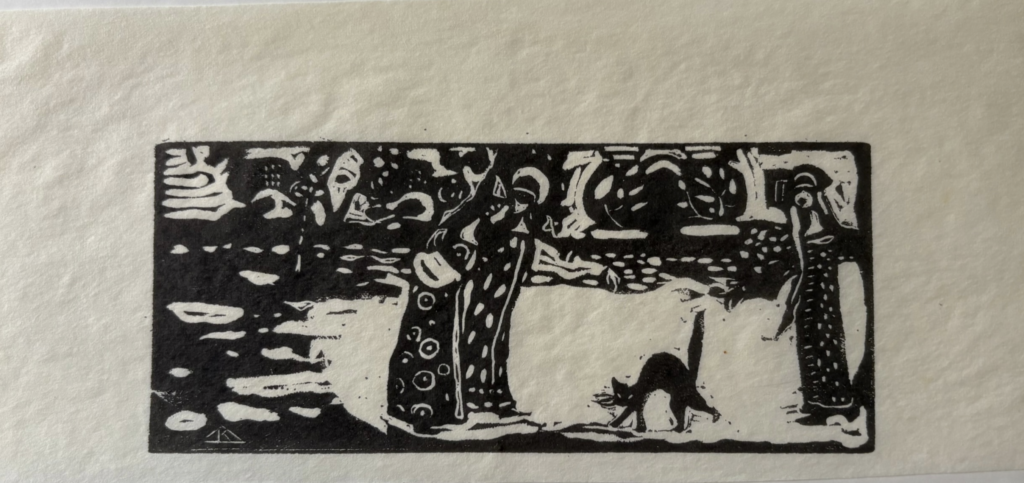
Katze (Cat) (1907)
Paul Gauguin
Sylvan Cole Gallery
Why Wood, Specifically: The “Primitive Matrix”
The appeal of the woodblock, for Gauguin, was almost sculptural rather than purely graphic. As one museum account puts it, the medium allowed him to work on a natural, “primitive” matrix, producing works that combined the sculptural gouging of his carved wood low reliefs with the evocative color of his paintings – while also providing seemingly endless opportunity for experimentation. The block wasn’t simply a surface to draw on. It was a piece of material he could physically carve into relief, the same way he carved his wooden sculptures, before ever inking it for a print.
That’s a genuinely different starting point than most printmakers bring to the medium. Where a traditional wood-engraver approaches the block as a means to an end – a way to reproduce a drawn image as faithfully and cleanly as possible – Gauguin approached it as a three-dimensional object whose carved surface carried its own expressive weight, independent of whatever image eventually got pulled from it.
Breaking Every Rule of How a Woodcut Is Supposed to Be Cut
Gauguin’s actual technique inverted the standard logic of wood-engraving almost entirely. Instead of engraving or digging deep lines into the block, as convention demanded, he scratched a fine weave of delicate lines into the surface with a sharp needle or burin, essentially applying a drypoint technique across the whole block, which he then combined with deeply incised lines and surfaces wherever he wanted sharp contrasts of light and shade. In other words, Gauguin ran two entirely different mark-making languages on the same block at once – a fine, scratched network for subtlety and atmosphere, and blunt, gouged cuts for drama and contrast – a hybrid nobody working in the traditional woodcut idiom had really attempted.
Nor did he stop once a block was carved. Critics examining his prints closely have noted that he keeps sanding the wood and incising again, often working in thin parallels rather than blocky outlines, so that marks read like points of light or a shower of rain, with a figure sometimes slipping into darkness or toward a flame, black becoming white in a later reworking. That’s the same restless, plate-as-battlefield instinct that later drove artists like Pissarro back into their own etched plates for successive states – except Gauguin was doing it to solid wood, sanding away his own carving and starting again mid-image.
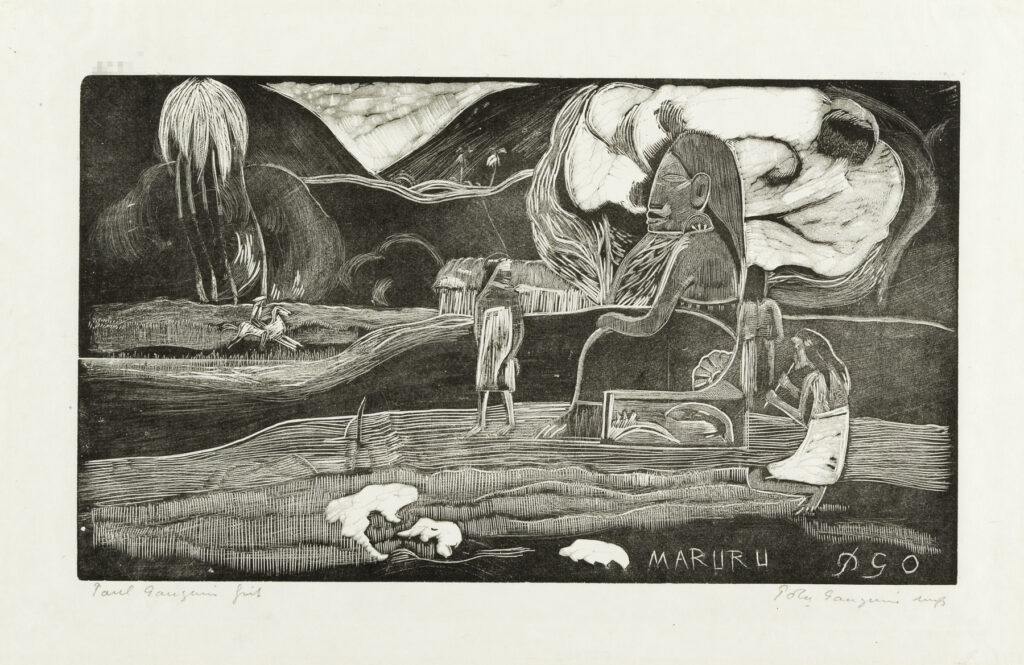
Maruru (1893)
Paul Gauguin
Christopher-Clark Fine Art
Printing Like a Painter, Not a Publisher
Gauguin’s inventiveness didn’t stop once the carving was finished. His most sustained print project, a set of ten woodcuts illustrating his Tahitian travel journal Noa Noa, shows him treating the print run itself as a space for continued experimentation rather than a mechanical reproduction step. He printed the Noa Noa blocks with various inkings and colour combinations, on different papers, and sometimes deliberately slightly off-register to create a blurred, dreamlike image – as seen in a print like The Gods. A conventional printer chases perfect registration and consistent inking across an edition; Gauguin chased the opposite, treating slight misalignment as a tool for mood rather than a flaw to correct.
His choice of paper carried the same intentionality. He printed compositions like Te Atua in black ink on japan paper – a tissue-thin sheet used in European printmaking since Rembrandt’s time – later mounting it onto heavier watercolour paper, a decision significant enough that scholars still highlight it specifically when discussing his technical choices. Recent scientific analysis of the surviving Noa Noa woodblocks has confirmed just how far this experimentation went, revealing Gauguin’s genuine ingenuity in formulating organic media to achieve specific visual effects – proof that what looks, at a glance, like rough-hewn simplicity actually rested on careful, sometimes chemically inventive, material decisions.
The variation Gauguin pursued through inking, paper, and registration meant that no two impressions of a single Noa Noa block ever looked quite identical – some prints from the series carry as many as nineteen documented variants pulled from essentially the same carved image, each one a distinct visual argument rather than a uniform copy.
Tahiti as Subject, and as License
The subject matter driving all this technical experimentation was inseparable from Gauguin’s own self-mythology. In the Noa Noa woodcuts, he constructed a romanticised vision of Tahiti as an untouched paradise of mysterious tradition, and the woodcut medium suited that vision in ways painting couldn’t quite match. The block let him create a genuinely dark image evoking the mysterious night world he associated with Tahiti – and, by extension, with his own subconscious – while also, unlike painting, not demanding a fully resolved, narrative composition. A woodcut, left partially resolved or roughly gouged, could gesture at mystery rather than explain it.
That sensibility connected Gauguin to a much older lineage he was consciously invoking. He likened the simplicity of his approach to the earliest woodcuts he knew, tracing back toward Dürer, treating the largely forgotten medium of woodcut as something he could revitalise as both “primitive” and modern at once – a deliberate collision of the archaic and the avant-garde that mirrored exactly what he was trying to do with his painted subject matter.
His Influence: Handing Later Artists Permission to Carve
Gauguin’s woodcut innovations rippled outward through European printmaking for decades. Vincent van Gogh’s brother-in-law’s circle aside, the more direct lineage runs through artists like Félix Vallotton, who by 1891 was already pushing woodcut toward Symbolism and a Japanese-inflected simplicity, and later through German Expressionists like Ernst Ludwig Kirchner, for whom the raw, gouged woodcut became a signature vehicle for emotional intensity. Each of these artists inherited, in some form, the permission Gauguin had effectively granted: that a woodblock didn’t need refined, engraver’s precision to carry serious artistic weight – that the visible evidence of the carving tool, the sanding, the rough edge, could be the expressive content itself rather than something to polish away.
Gauguin’s seventy-eight surviving printed compositions across woodcut, etching, and lithography represent, in that sense, a genuine turning point for the medium’s status within modern art. He didn’t just make woodcuts. He argued, through the sheer technical audacity of his approach, that the “primitive” roughness of the form was exactly what made it modern – a case no European printmaker working in the medium’s polished nineteenth-century tradition had made quite so forcefully before him.
His decades-long, prolific relationship with master printers like Crommelynck also modeled something important about the craft side of contemporary printmaking: that an artist’s most experimental, boundary-breaking ideas often still depend on a technician’s deep expertise to actually survive contact with the plate. Dine’s nearly one thousand prints stand as proof that raw physical aggression and refined craftsmanship aren’t opposites in printmaking – they’re collaborators.
The Takeaway
Gauguin came to the woodblock the way he came to Tahiti – looking for something rawer and less domesticated than what Europe had on offer, and willing to break the medium’s own conventions to find it. Scratching fine drypoint lines into a surface meant for deep gouging, sanding away his own carving mid-composition, printing deliberately off-register to blur an image into dream — every one of these choices treated the “correct” way to make a woodcut as an obstacle rather than a rule. What he left behind wasn’t just a body of prints. It was a permission slip for every artist after him who wanted their tools to show.