Details — Click to read
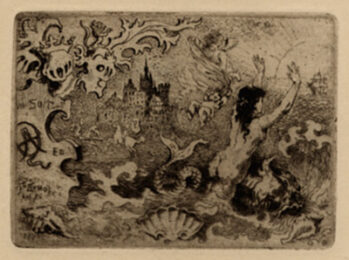
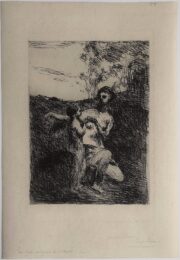
Etching, aquatint and drypoint, 238 x 160 mm. Bourcard & Goodfriend 18bis, 1st and 2nd state (of 2).
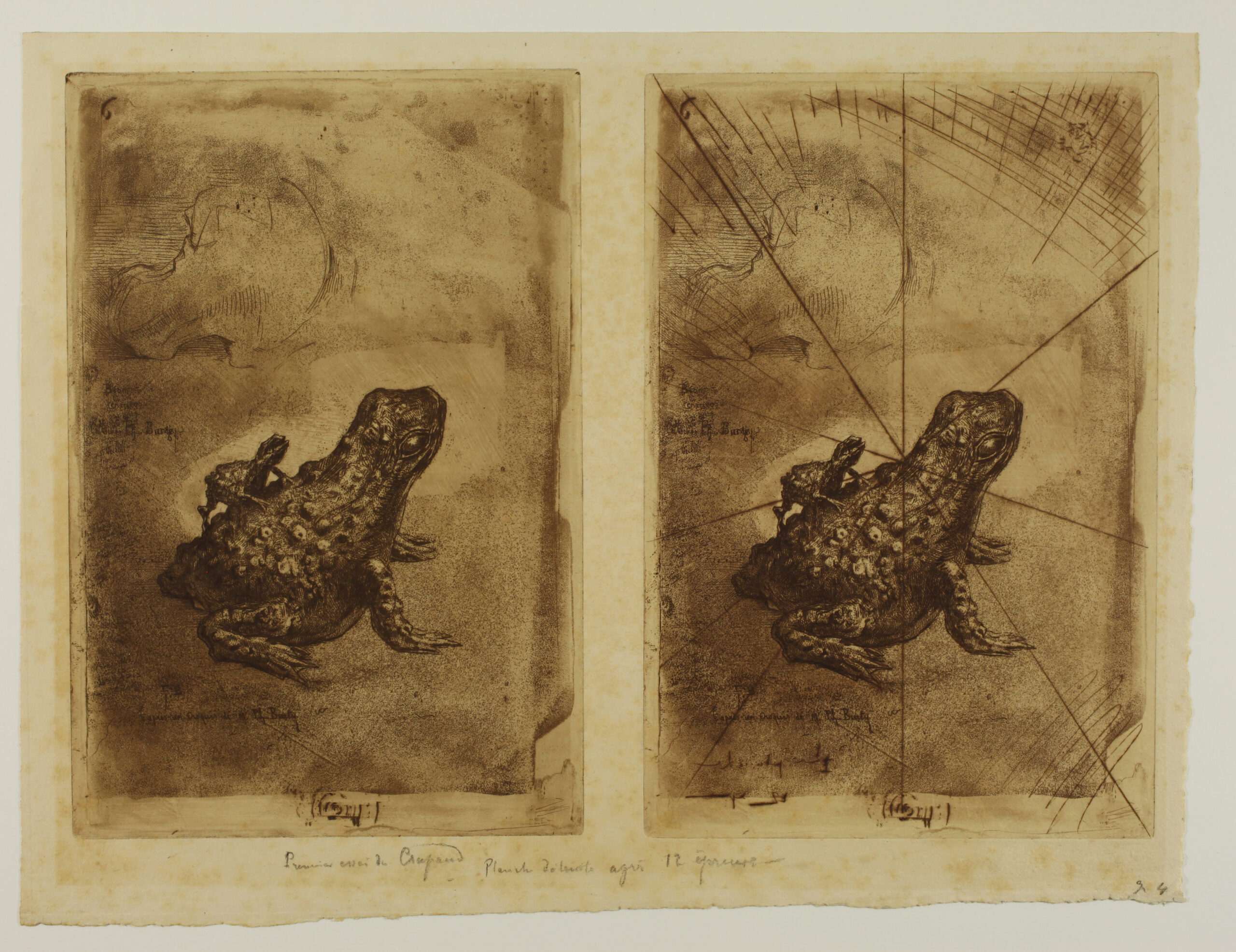
Set of two extremely rare impressions, printed in brown on the same sheet of laid watermarked paper (Arches).
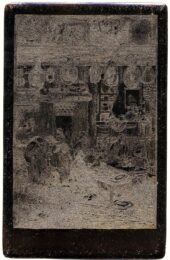
Impression on the left: impression of the 1st state (of 2), before cancellation of the plate.
Impression on the right: impression of the 2nd state (of 2), the plate cancelled, with Buhot’s owl added in the upper right corner and with the words Ire planche 12 épr. [1st plate 12 impressions] in the bottom left-hand corner.
The sheet is annotated in pencil in the lower margin: Premier essai du Crapaud Planche détruite après 12 épreuves. [Crapaud, first attempt, Plate cancelled after 12 impressions]. And in the lower right-hand corner: ep [?] 4.
Tiny foxmarks, otherwise in perfect condition. Full margins (sheet: 278 x 365 mm).
A similar sheet in the Philadelphia Museum of Art bears a very similar inscription in the lower margin: Premier essai du crapaud et Détruit après tiré à douze épreuves [Crapaud, first attempt, Printed Plate cancelled after 12 impressions].
An impression of the cancelled plate alone is in the New York Public Library. It is annotated Premier essai du Crapaud Bronze de la collection de M. Ph. Burty. Planche détruite après 12 épr [Crapaud Bronze from the collection of M. Ph. Burty, first attempt. Plate cancelled after 12 impressions].
Gustave Bourcard does not assign a number to this first version of the Crapaud Bronze in his catalogue, but he writes at the end of his description of the final version (Bourcard 18, translated by us): ‘There was a first plate, destroyed after very few impressions’. Nor does he mention the existence of any impressions made from the cancelled plate. Number 18bis is attributed by James Goodfriend in his supplement to the catalogue raisonné. He mentions the existence of impressions after the plate had been cancelled. Citing the cancelled impression in the New York Public Library, he points out that his annotation does not make it possible to know whether or not all 12 impressions it mentions are cancelled. However, if we consider that Buhot ‘destroyed’ the plate by cancelling it, we should perhaps understand that the twelve impressions in question came before this cancellation and that the few known cancelled impressions are additional. The fact that the mention of a print run of twelve impressions is also found on sheets with two impressions printed on it, one cancelled, the other not, suggests that Buhot must have printed trial proofs and decided shortly afterwards to cancel his plate.
However, the two versions of the plate are very similar. In the first version, the toad etched at the top of the plate is barely sketched, and the night sky added by Buhot behind the toad in the final version is still missing here. The final plate was published in the Japonisme, dix eaux-fortes, in April 1883.
« On April 10, 1883, the first major retrospective exhibition of Japanese art in the Western world opened in Paris at the Gallery Georges Petit on the rue de Sèze. It was comprised of paintings, ink drawings, bronzes, lacquers and woodblock illustrated albums, all dating from the ninth century through 1868, the year of the Meiji restoration. The exhibition was organized by Louis Gonse, Director of the Gazette des Beaux-Arts ; the art objects themselves were borrowed from the rich private collections of such longtime Japanophiles as Gonse, Philippe Burty, S. Bing, Theodore Duret, and Alphonse Hirsch. » (Phillip Dennis Cate, p. 64).
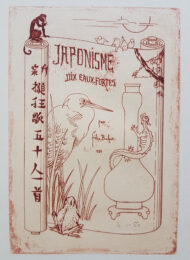
Around the same time, Félix Buhot published Japonisme, dix eaux-fortes, representing a selection of Japanese objects from Philippe Burty’s collection, exhibited at the Galerie Georges Petit. With the exception of Crapaud Bronze, the etchings do not date from 1883 but from 1875, as Buhot specified to Octave Uzanne on 4 April 1883 (quoted by Ph. D. Cate). By publishing the set in April 1883 under the title Japonisme, at the same time as Georges Petit’s exhibition, Buhot intended to participate in a common effort to encourage the general public to discover Japanese art and the studies that intellectuals such as Louis Gonse, Théodore Duret or Philippe Burty had been undertaking for several years.
References: Philippe Burty : « Félix Buhot, Painter and Etcher » in Harper’s New Monthly Magazine, LXXVI, Février 1888, pp. 333-334 ; Phillip Dennis Cate: « Félix Buhot & Japonisme » in The Print Collector’s Newsletter, 1975, vol. 6, no. 3, pp. 64-67.