Retour de Russie (Return from Russia)
Artwork details
- Artist
- Théodore Géricault
- Title
- Retour de Russie (Return from Russia)
- Description
-
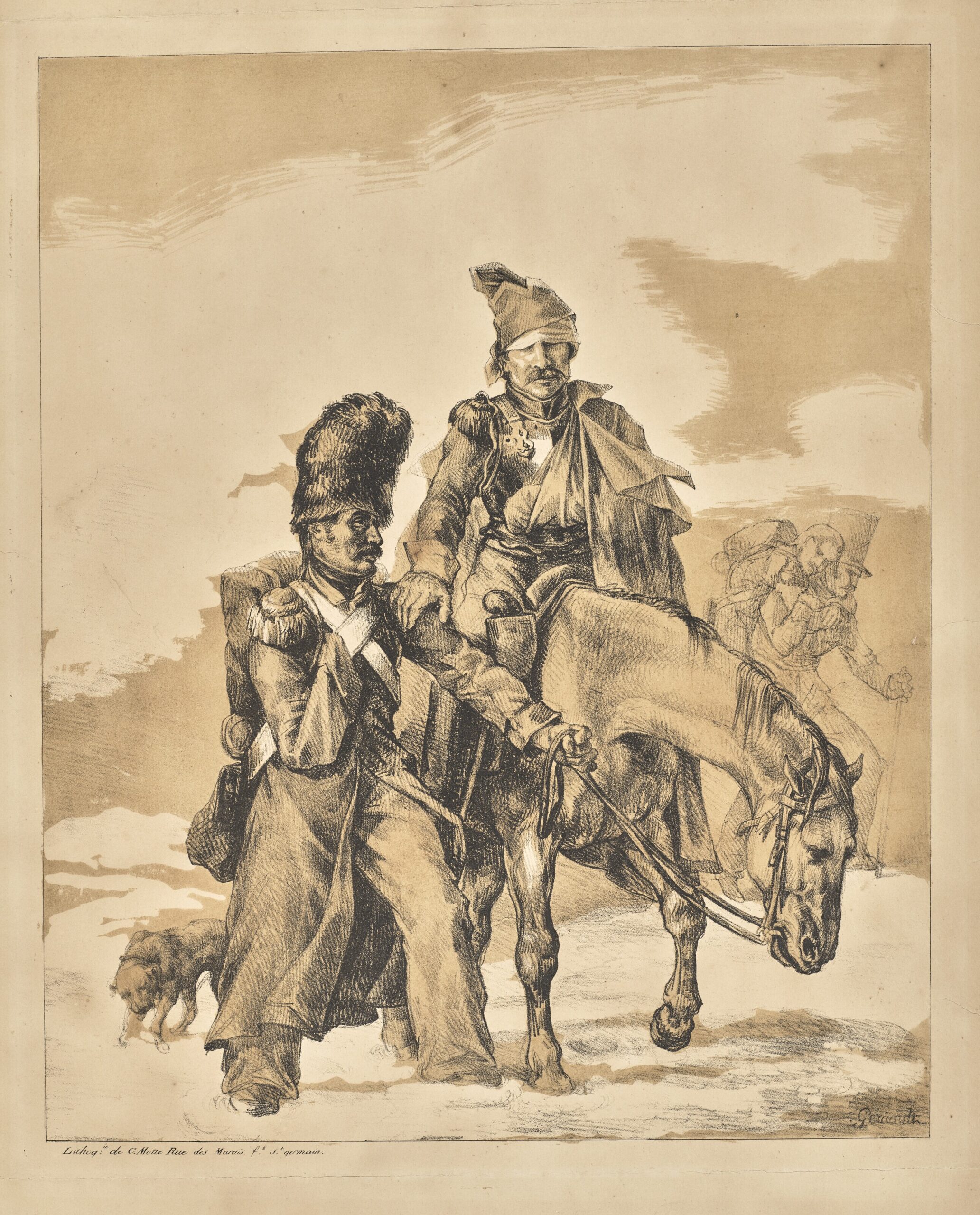
lithograph printed from two stones in black and light brown on wove paper, Johnson's third state (of six), with the address of the lithographer C. Motte below the subject lower left and before the title and the later address at Quai Voltaire below the subject lower right.
A rare work from the early years of lithography
Further Literature
Delteil Le peintre graveur illustré, XIXe et XXe siècles, 1924, no. 13
F, Bergot, A. Jacques et al. Gericault: Tout l'oeuvre Grave et Pieces En Rapport, Rouen, 1982 no.12
G. Bazin, Théodore Géricault - Étude critique, documents et catalogue raisonné - Vol. 5 - Le Retour à Paris: Synthese d'Expériences Plastiques, Paris, 1992, pp. 140-141, no. 1461.
R. S. Johnson International, exh. cat., 19th-Century French Prints Drawings & Bronzes, Chicago, April 1985, no. 65, pp. 90-91 (another impression ill.).Géricault's Retour de Russie is one of the most poignant images of the famous retreat from Moscow which decimated the once all powerful French army. For the invasion of the Russian Empire in 1812 Napoleon had assembled the largest army European history had ever seen; but after the capture of Moscow, then the retreat to France, Napoleon lost most of his remaining army in savage winter conditions to cold, disease, starvation as well as sporadic attacks from the Russian army. Figures vary, but it has been said that between 600,000 -650,000 troops crossed into Russia and between 20,000 - 112,000 returned
At the time of the creation of this lithograph, Napoleon was in exile on the island of St Helena in the Atlantic, following his final defeat at Waterloo.
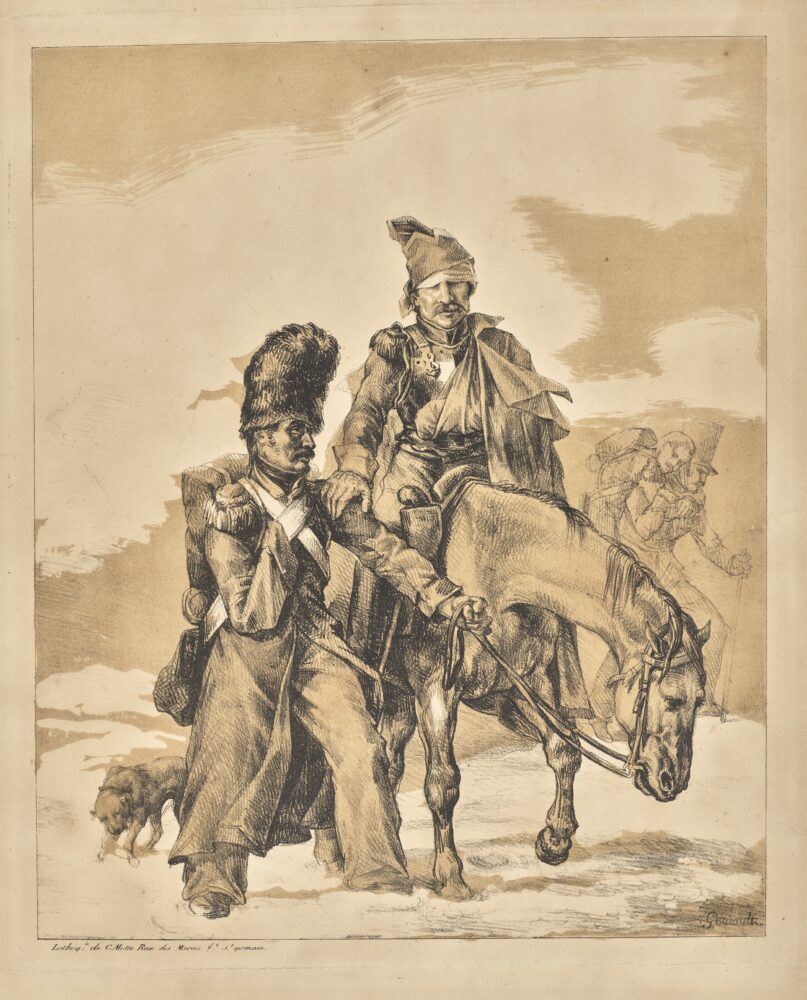
The lithograph shows both the suffering and the camaraderie of the wounded French soldiers as they struggle through the snow on their way back to France, a faithful dog also following behind them.
This incunable of printmaking, created the same year that the artist began work on the celebrated Raft of Medusa (exhibited at the Salon in 1819) is often thought of as the first colour lithograph by an artist. Lithography had only been 'perfected' by Senefelder in Germany in 1796 and Napoleon himself was very keen on the possibilities that it offered - not least for military purposes - maps and sending orders. Dominique Vivant Denon director general of the museums in France also practiced lithography himself and encouraged workshops to be set up in Paris. One of these was set up by Charles Motte, one of the very first Parisians to be granted a licence (31 October 1817). Motte worked at 13 rue des Marais, Faubourg St. Germain, Paris in 1818-1830 and later also set up in London (Leicester Square, followed by Bedford Street, then St Martin's Lane). Gericault worked extensively in lithography between 1817 and 1823 both with Motte and with Engelmann in London but died in January 1824 at the age of only 32. Géricault's younger contemporary Delacroix was another of the Romantic artists who embraced lithography from an early stage.
Examples of the lithograph (in the later versions) are in the collections of The National Gallery of Art, Washington; The Art Institute of Chicago and The Harvard Art Museum.
- Date
- 1818
- Medium
- Lithograph
- Edition
- unknown but rare
- Signature
- Signed In Plate
- Catalogue Raisonne
- Delteil, 1924 no. 13; Rouen, 1982, no. 12
- Image
- 44 x 36 cm
- Sheet
- 58.5 x 42 cm
- Status
- Available
- Price
- Price on request