Details — Click to read
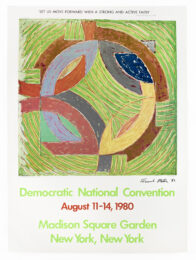
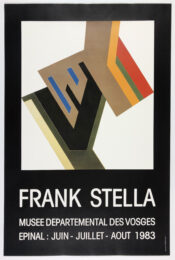
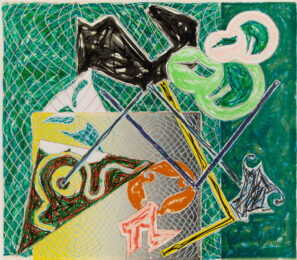
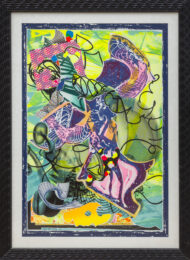
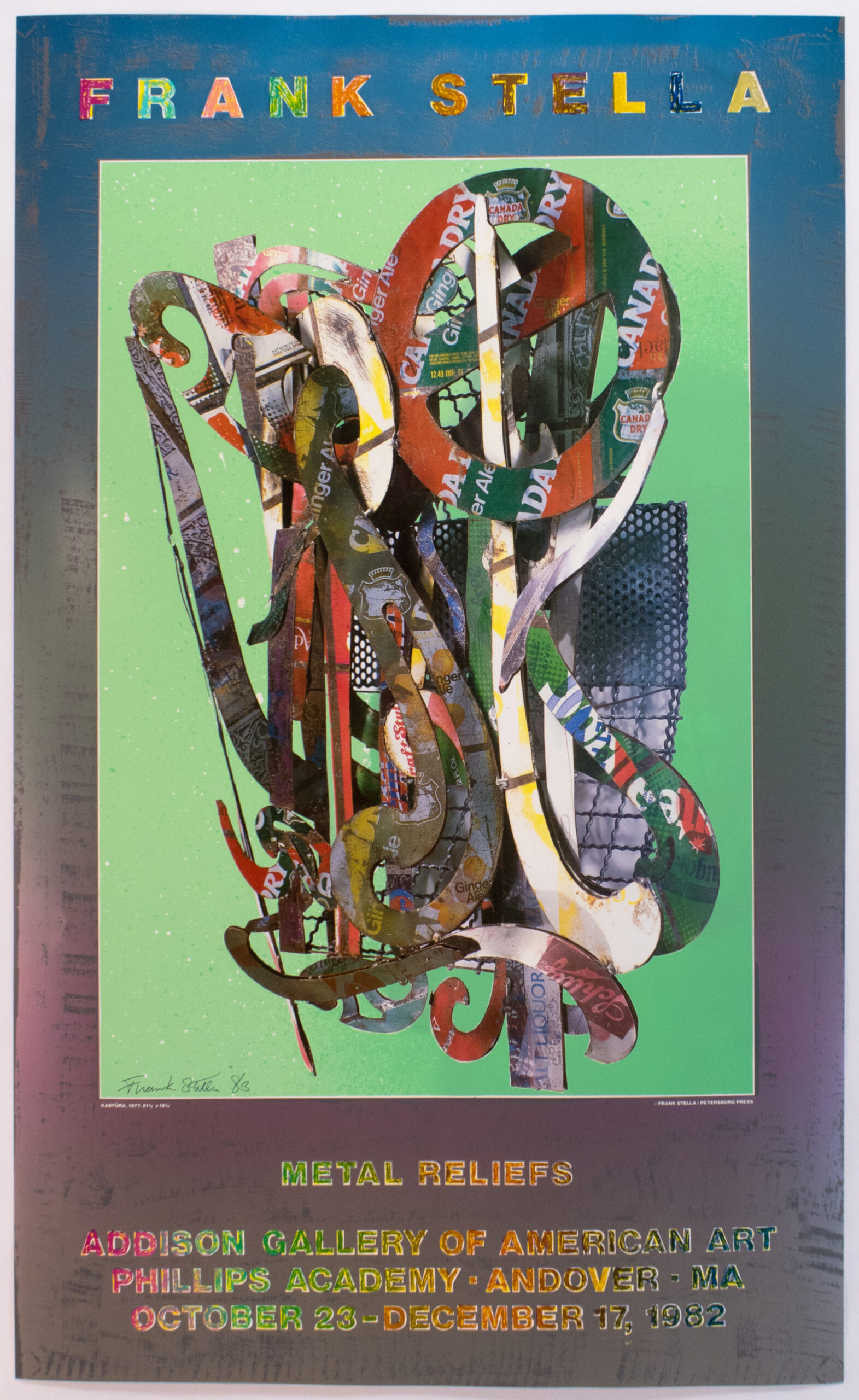
Original exhibition poster for Frank Stella’s Metal Reliefs exhibition at the Addison Gallery of American Art, at the Phillips Academy in Andover, Massachusetts. Printed on fine paper (Warren Lustro Dull paper); signed by the artist and dated 83 lower left.
In 1982 Frank Stella was asked by the Addison Gallery at Phillips Academy, where the artist had attended high school, if he would design a poster for their exhibition of his Indian Birds: a series of large, colorful mixed media works on metal relief. Five years earlier Cornwall-Jones had encouraged the artist to travel to the renowned Sarabhai family’s fabric mill in Ahmedabad, India, where he arranged for artisans to aid Stella in constructing a series of small works from sheet metal. These works would later become the maquettes for Indian Birds.
Proofing and printing the were executed both at the printing studio Petersburg Press had set up for the artist in his home in the West Village in New York, as well as Petersburg Press’ own studio facility at Lafayette Street. One of the printers recalls wheeling stacks of posters across Washington Square from Lafayette Street to the artist’s studio.
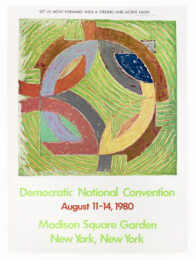
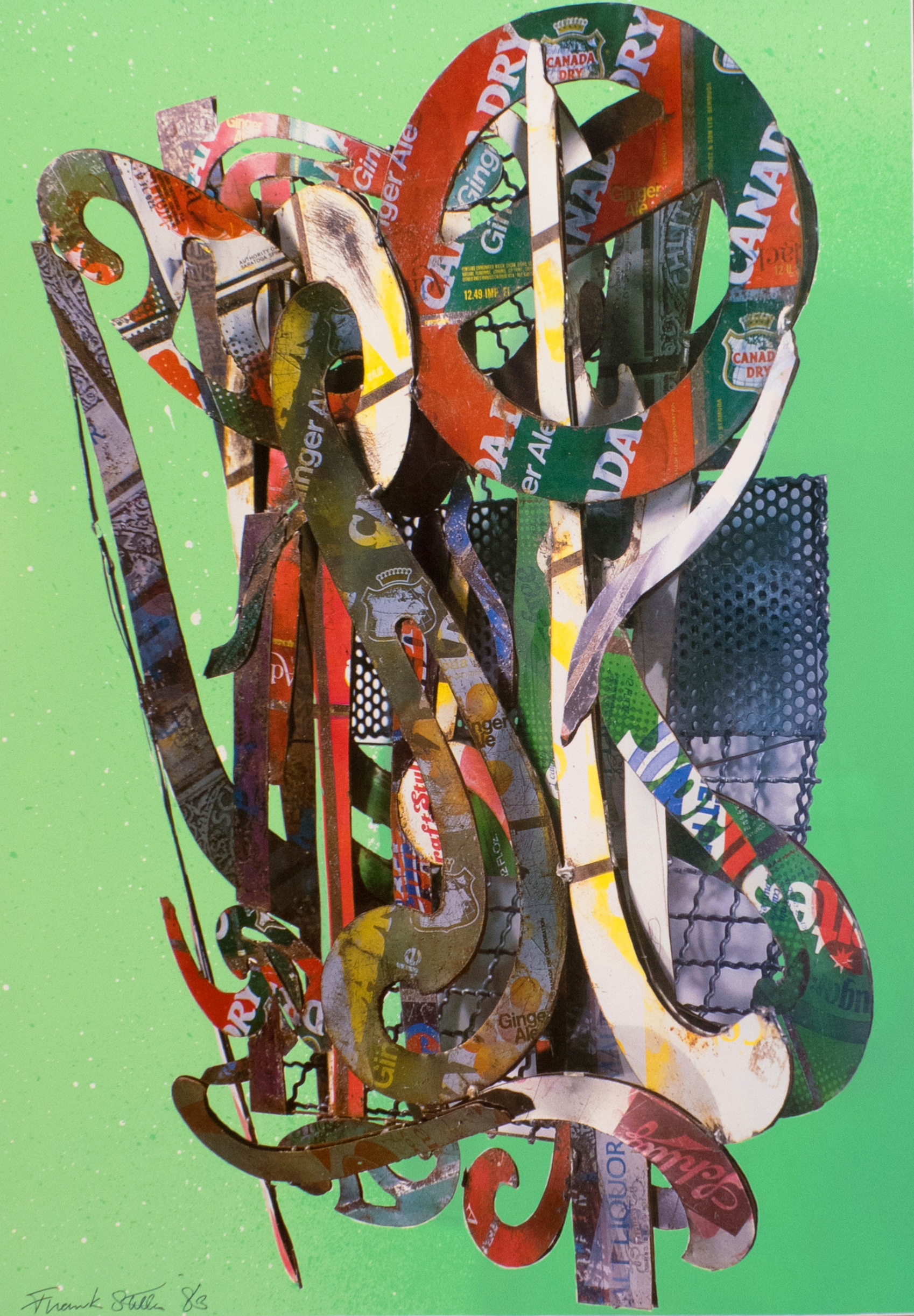
A steel-grey metallic border, spatter painted green background, and brilliant rainbow type highlight the centerpiece: the 1979 maquette for Stella’s 1979 sculpture Kastūra, a large aluminum and wire mesh sculpture with colorful oil paint covering the surface. The poster’s multicolor metallic ink replicates beautifully the surfaces of Stella’s metal relief sculptures. The artist painted on etched metal sheets and formed overlapping, cutout patterns that twisted into curves, sometimes incorporating ground glass surfaces and honeycomb aluminum.
Stella brought an expressive approach to these sculptures: “For me, painting these metal reliefs is a way of infusing the piece with life; the brushstrokes, the flow of paint, might be compared to the circulatory process in the body.”
Frank Stella’s Massachusetts show was particularly meaningful, as he attended high school at Phillips Academy, where the small but prominent Addison Gallery of American Art features a robust collection of 19th and 20th century art. It was at Phillips Academy that Stella first studied Josef Albers and Hans Hoffman, who he describes as his two biggest teaching influences.
A steel-grey metallic border, spatter painted green background, and brilliant rainbow type highlight the centerpiece: Stella’s 1979 sculpture Kastūra, a large aluminum and wire mesh sculpture with colorful oil paint covering the surface. The poster’s multicolor metallic ink replicates beautifully the surfaces of Stella’s metal relief sculptures. The artist painted on etched metal sheets and formed overlapping, cutout patterns that twisted into curves, sometimes incorporating ground glass surfaces and honeycomb aluminum. The Andover show featured smaller scale works, as well – sculptures Stella made in India, using techniques from local craftspeople.
Stella brought an expressive approach to these sculptures: “For me, painting these metal reliefs is a way of infusing the piece with life; the brushstrokes, the flow of paint, might be compared to the circulatory process in the body.”
Frank Stella’s Massachusetts show was particularly meaningful, as he attended high school at Phillips Academy, where the small but prominent Addison Gallery of American Art features a robust collection of 19th and 20th century art. It was at Phillips Academy that Stella first studied Josef Albers and Hans Hoffman, who he describes as his two biggest teaching influences.